




 13 Apr 2016
 Posted by Theresssa Takasaki

 Loading ...
Sideways: Memoir of a Misfit is available for purchase via Diaspora Press, the Japanese Canadian Cultural Centre, the Nikkei National Museum and Cultural Centre, and Nikkei Books.
At the Moriyama Nikkei Heritage Centre at the JCCC, author Diana Morita Cole hosted a reading of her book Sideways: Memoir of a Misfit, which details her beginnings at Camp Minidoka to her family’s subsequent relocation to Chicago. Nikkei Voice had the opportunity to speak with Morita Cole following the event on publishing her book and on unearthing the past.
Nikkei Voice: When did you first conceive of the idea to write a memoir? And why a memoir in specific (as opposed to a work of fiction, or a “based on”, etc)?
Diana Morita Cole: I had been struggling to write the story about my identity for a very long time. In fact, I’ve not only been struggling to write my story, but even more importantly, struggling to figure out just who I am as I wrote Sideways.
I’d written several small essays about my strange life and never conceived of these essays turning into a book until I became a member of an immigrant writer’s group in Nelson in 2011. I had written these essays about my life, but they were written in the immediacy of the moment, not from the perspective of a lonely little girl. It was only through reflection — when I had the perspective of an elder — that my story took shape.
I had no idea that my first attempt would morph into a memoir, but my story happily suited that genre form precisely because I focused on a specific period ––from my birth to my graduation from high school –– rather than on a timeline that would have taken in my entire life.
Also, I wrote my story as a piece of creative nonfiction because, while the facts of my life were vital, I wanted to be able to take a few liberties in order to move the story ahead. My sister Betty and brother Claude were heavily invested in what I was writing – they provided the background to my story, as memories aren’t always in sync. In the end it came as no surprise that Sideways turned out to be a story of my family, the Moritas of Hood River, Oregon as well as a story about myself.
NV: Are there any stories or memories in the book that you’re particularly fond of?
DC: I never tire of giving readings of the first chapter of Sideways – the imagery and the humour never ceases to delight. Also, I especially enjoyed writing the Postscript, which is about the Japanese Canadian diaspora, in my current adult voice.
However, if I were pushed to identify my absolute favorite chapter, I’d have to say it was the story about my brother Claude and myself. His story allowed me to grapple with all the interesting misfits that were part of the ghetto community in Chicago where I grew up. And I particularly enjoyed the process of writing this chapter because I found myself creating an ending that turned out to be a complete surprise to me. Writing is a fascinating adventure.
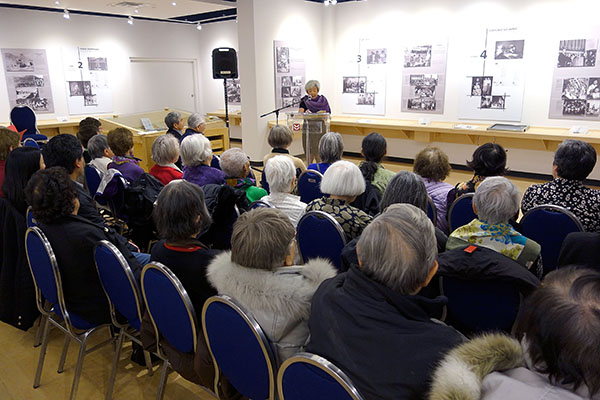
Diana Morita Cole, at the front, doing a reading for an audience at the Japanese Canadian Cultural Centre of her new book.
NV: Do you have any sources of inspiration or motivation, particularly when it comes to writing?
DC: From a very early age, I was told stories about what happened to my family during their detention in Pinedale Assembly Center, Tule Lake internment camp, and in Camp Minidoka, and about their trauma of being torn away from the Shangri-La they knew in Hood River.
And so, at an early age I was made to feel responsible for my family’s suffering and for the injustices my parents suffered at the hands of my grandparents. And the stories I heard again and again instilled in me a very deep sense of justice—about what is just and what isn’t just. It is through this lens that I’ve viewed the world for my entire life.
I think it is to the credit of the Nikkei that they have overcome and transcended the miseries that were wrought upon them. I also think this success has come at a very dear price: we have been forced to erect a Model Minority façade that we hide our true selves behind. And this hidden story is an important story to tell because these revelations can help us to heal.
NV: Who or what audience do you hope this book will reach?
DC: First, I dedicate my memoir as an homage to the Nikkei community, particularly the Nisei and Issei, for what they endured and the grace with which they lived their lives in order to give the subsequent generations a much happier life than they had. Secondly, I’ve written this book for the broader communities in Canada, the US, Australia, Latin America, and in Japan in order to give insight into why discriminatory policies that were sanctioned by undemocratic processes, specifically Executive Order, Orders-in-Council, and the War Measures Act, should not be implemented again.
As well, I look forward to meeting many interesting people wherever I’m allowed to present my story. In particular, I look forward to meeting Roy Miki and the Murakamis of Salt Spring Island, who encouraged me to write Sideways.
***


2 Comments