
 23 Oct 2025
 Posted by Kelly Fleck


 Loading ...
What if the most powerful story you ever learned was the one your family never told you? Mandy Shintani with the sword her father, George, held onto for almost 80 years. The sword now has a new home at the Nikkei National Museum. Photo courtesy: Mandy Shintani.
VANCOUVER — For Mandy Shintani’s entire life, there was a secret hidden in the closet of her parents’ home in a small town in Ontario. Safely wrapped up and tucked away was a 450-year-old samurai sword belonging to her father, George Shintani.
On rare occasions, her father would take the sword out of the closet, likely to show it to a Nikkei friend. George would slowly and carefully handle the ancient sword, and a hush would fall over the home, as if witnessing a special ceremony. The sword was a thing of beauty and strength, but also felt dangerous and scary to a young Shintani.
“Even as a really young kid, I just knew [the sword] was something that we would never discuss outside our family. I never even felt the urge to do it because I had a sense of how important that was to our family and who we were that we didn’t let other people know about it,” Shintani tells Nikkei Voice in an interview.
Despite being hidden away, Shintani thought about the mysterious sword throughout her life. Now, Shintani is taking the sword out of the closet and finally uncovering its story. To do that, she set out to understand her father and family’s wartime experiences and broader Japanese Canadian history. Shintani documents this journey of discovery in the podcast The Samurai in Our Closet.
Shintani felt a push to uncover the story behind the samurai sword when George passed away in 2022 at 96 years old.
“I think part of the grieving process is that you want to learn more about that person, you’re really trying to gather as many stories as possible to get through that process of sadness and loss. And then there were so many mysteries. I wanted to find out more about my father,” says Shintani.
When Shintani isn’t uncovering family mysteries, she is a Vancouver-based occupational therapist, gerontologist, and small business owner. She also serves as chair for the Japanese Canadian War Memorial Committee.
The podcast was created with support from a Japanese Canadian Legacies Society community fund grant. While writing the grant application, Shintani realized it was time to explore this history. She wanted to tell this story before the Nisei generation is gone and can no longer share their stories.
“A lot of my [Sansei] cousins are already gone too…I dedicated [the podcast] to them because I feel like they never really got a chance either to fully understand the stories,” she says. “And then for my children, too. I didn’t tell them any stories either, and I didn’t want it to continue on with the Yonsei and Gosei generation as well.”
Shintani first learned that her family was incarcerated during the Second World War while in high school. She thought it couldn’t have happened to her family because they never talked about it. As George aged, he started talking more about his life before and during the war. But as Shintani began her research, she discovered there was so much more to his stories, which she shares in the podcast.

George Shintani and his family in Sandon internment camp during the Second World War. Photo courtesy: Mandy Shintani.
George was born in Vancouver’s downtown eastside. As a teenager, he was labelled an enemy alien, and his family was forcibly uprooted, first to Hastings Park, and then Sandon, a mining ghost town.
Shintani knew her father served in the Canadian Army during the Second World War; he told her he was a translator. Much later, she learned that George was recruited by the Canadian Intelligence Corps at just 19 and was a linguist and interrogator with the British Army in Southeast Asia. It was there that he received the sword from a surrendering Japanese officer.
George investigated one of the most notorious war crimes in history, the building of the bridge over the River Kwai. It must have been a heavy responsibility for the young Japanese Canadian men; their work would help decide the outcome of the rest of the surrendered soldiers’ lives, says Shintani.
George experienced and witnessed some of the worst in humanity, both in service overseas and at home in Canada, where he faced racism and discrimination, stripped of his rights and dignity. Despite this, Shintani describes George as a loyal Canadian who spoke modestly about the incredible things he had done in his life.
“My dad was…very hard working, optimistic, and he was an incredibly loyal Canadian. His view—and I realized this is very Japanese in some perspective—was always, ‘What can I do as a person to make this country a better place?’” says Shintani.
George left behind a journal and an interview with the Nikkei National Museum & Cultural Centre, but to fully understand George’s story, Shintani wanted to understand the wider Japanese Canadian experience. She interviewed over 70 experts, historians, local guides, artists, writers, family members, and community members, whose voices and stories feature throughout the four-episode podcast series, creating a beautiful mosaic that shines a light on the years before, during, and after the Second World War.
In the podcast’s final episode, she looks forward towards the community’s future and how younger generations are recovering the stories of their ancestors and connecting to their culture.
One voice featured in the podcast is Mary Kitagawa, an educator, internment camp survivor, and human rights advocate. Kitagawa and her husband, Tosh, have been speaking out about Japanese Canadian history since the 1990s by sharing their experiences with audiences of all ages.
While most Japanese Canadian families do not have a 450-year-old samurai sword hidden in their closets, many families have hidden away parts of their history, identity, and culture, and never passed their stories on to the next generations. Among the many reasons, Kitagawa says, in this silence was a fear that if they spoke out, they may suffer again or that the memories were too painful to share.
Even though Kitagawa and her husband are in their 90s, they continue to share their stories. Kitagawa says her parents talked openly about what happened during the war and encouraged her and her sisters to use their voices to stand up for what is right. Kitagawa’s story is also being explored in a forthcoming book, Mary Kitagawa: A Nikkei Canadian Life, by Karen M. Inouye.
“My parents gave us a voice to speak up against injustice, and they always told us never to be silent. And always speak up for people who have no voice to express what they have in their hearts,” says Kitagawa. “If we remain silent, no one is going to know our story.”
Kitagawa also stresses the importance of using the correct language when speaking about the community’s history, avoiding euphemisms of the time that were used to distort what was done to Canadians of Japanese heritage. In the podcast, Kitagawa shares the painful story of seeing her father being forcefully taken away from the family home on Salt Spring Island.
Kitagawa was a child during the incarceration, and shares how her mother did whatever she could to make life as normal as possible for her children.
“Mary’s [story] really reflected what truly happened during that time period and how challenging it was, especially for the Issei [and Nisei] mothers,” says Shintani.
Shintani worked with a 10-person committee to research and create the podcast. Since the podcast launched, she has heard from many Canadians of Japanese heritage who were learning details about the history for the first time.
Shintani believes part of the reason George hid the sword for so long was to protect it, feeling he was the custodian of the sword, but not its owner. It was not something he could sell or financially benefit from. George had a deep respect for the sword and wanted to find a way to return it to the original family. A samurai sword holds profound significance for the family it belongs to, representing lineage and honour, and is passed down through generations of a family. Shintani learned that for a Japanese officer, surrendering his sword was like giving up his life. Many believed samurai’s spirits—their ancestors—were carried in the sword.
“He felt it didn’t belong to him. After all that he endured, and maybe because he understood what that was like to have something taken away from you during the times of war and the need of that family to have it returned,” says Shintani.

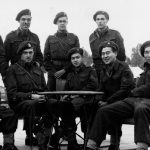
A young George Shintani in Malaysia, circa 1946. Photo courtesy: Mandy Shintani.
There are stories, including one of a Japanese Canadian soldier, returning swords to families decades later with the help of the Japanese government. Often, these swords have some kind of identification, such as a name or family crest, which George’s sword did not have. Shintani learned it would be virtually impossible to find its original owner.
The Shintani family donated the sword to the Nikkei National Museum & Cultural Centre in Burnaby. No longer hidden in a closet, the sword is now a rare treasure that can help teach Canadians about the history behind it.
For Shintani, creating this podcast became a healing journey, deepening her understanding of her father, mother, sisters, and herself. Shintani echoes a sentiment her sister, Claire, shares in the podcast, that after uncovering their history, she feels like a weight has been lifted.
“I’m sure [my father would] feel honoured that I was looking at his life, but I think what he would be most excited about is that it actually helped me to understand the Japanese Canadian community,” says Shintani. “I can’t even put into words what I got out of doing this podcast because it was really life-changing. And as my sister described, she just felt lighter…We’re so proud of our history. And, at the same time, I think we feel sad that we can’t thank the Nisei and the Issei now that we know the story.”
Creating the podcast and meeting Japanese Canadians from across the country, hearing their stories, has also helped Shintani find a sense of community that she thought was lost. Shintani hopes the podcast will prompt listeners to explore their own origin stories and ask their family questions—while of course recognizing that not everyone may want to share their stories.
“They may not be up to sharing a lot of details, but I think they really appreciate that we want to hear the stories. It got to the point where we got into the habit of them not telling the stories, and we got in the habit of not asking questions,” says Shintani.
For people who cannot ask their family questions, she hopes they can explore some of the tools she used while creating the podcast, like the Sedai Project from the JCCC, Landscapes of Injustice, and books, films, and media created by Canadians of Japanese heritage.
“I hope it makes Gosei and Yonsei excited about pursuing their projects and continuing on with the stories. And I hope people realize that we have a whole community of people out there that could be your friends or your long-lost cousins. They’re all out there, we just need to start having conversations with them,” says Shintani.
***
To learn more and listen to The Samurai in Our Closet, visit www.thesamuraiinourcloset.com.
Mandy Shintani, along with researcher and historian Susan Yatabe, will give a live presentation at the Japanese Canadian Cultural Centre on Nov. 30. For more information, jccc.on.ca/event/2025/11/samurai-our-closet.