




 01 Aug 2025
 Posted by Kelly Fleck


 Loading ...
Highlighting the career and lasting legacy of the late Frank Moritsugu, a journalist, war veteran, and advocate.
TORONTO — At a time when Japanese Canadian names did not appear in bylines of mainstream news outlets, Frank Moritsugu’s stood out. Over a career that spanned more than eight decades, he became one of the first Japanese Canadian journalists to write for mainstream publications. Beyond journalism, Moritsugu was a war veteran, teacher, author, judoka, advocate for justice, and beloved Nikkei Voice columnist.
Frank Akira Moritsugu died peacefully on May 19, 2025, in the palliative care ward at Etobicoke General Hospital, at the incredible age of 102.
Moritsugu was still a teenager when he was hired by The New Canadian and wrote for Nikkei Voice until earlier this year. Moritsugu worked for publications such as Maclean’s, Canadian Home & Gardens, CBC, the Toronto Star, and Montreal Star. But journalism wasn’t always the path Moritsugu envisioned for himself.
“Back in B.C., when we were growing up, you never saw a Japanese name in the bylines of any newspapers,” Moritsugu told Nikkei Voice in a 2022 interview.
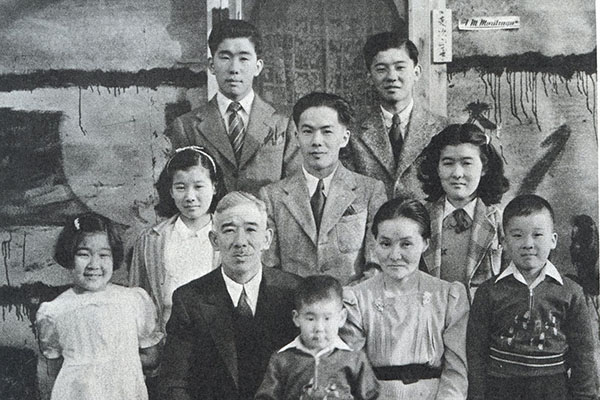
The Moritsugu family during a temporary reunion in Tashme. Top row: Ken and Harvey. Centre row: June, Frank, and Eileen. Front row: Joyce, father Frank Masaharu, mother Shizuko, and Henry. Ted, the youngest, stands in front between his parents. Photo courtesy: Frank Moritsugu.
Becoming Frank
Moritsugu’s parents, Masaharu and Shizuko Moritsugu, immigrated from Tottori, Japan. Masaharu arrived first in 1912 and worked as a labourer. Through work, he picked up English and was given the name Frank—it was easier for Canadians to say. He returned to Japan and married Shizuko on Christmas Day in 1921.
Shizuko followed her new husband to Canada, and Moritsugu, the first of eight children, was born the following year on Dec. 4, 1922, in Port Alice, B.C. Two more children were born in Port Alice, and the next five were born in Vancouver after the family moved in 1926.
When it was time for Moritsugu to start kindergarten at the Japanese United Church, Shizuko—formerly a teacher in Tottori—taught him the English and Japanese alphabets as well as the national anthems of Canada and Japan. His parents expected him to do well in school, and he did.
Moritsugu’s name was Akira until he was seven years old. While attending the Japanese Anglican Church in Kitsilano with his siblings, the minister told him he needed to adopt an Anglicized name to be baptized. He went home and told his father, who said that as the eldest son, he would also be Frank.
Moritsugu’s journalism career began in 1940 with his school newspaper, Kitsilano High School Life, where he was later elected editor-in-chief by his peers. But unlike his classmates, post-secondary education was not an option for Moritsugu.
“Because of the depression era, and [since] I was the oldest of eight kids, there was no way—despite the fact that I did reasonably well in high school—for me to go to university, the family couldn’t afford it,” said Moritsugu.
The war years

Nineteen-year-old Frank Moritsugu sitting on the roof of one of the Yard Creek camp shacks in 1943. Repository: JCCC. Collection: Dawn Miike Collection, Accession Number: 2014.02.01.09
But life was about to change forever. Just eight days after Japan bombed Pearl Harbor, The New Canadian editor Tom Shoyama recruited Moritsugu. While under government censorship, The New Canadian was the only Japanese Canadian newspaper permitted to publish during the war, keeping the community informed during the forced uprooting on the West Coast.
The Moritsugu family was sent to Tashme Internment Camp. Moritsugu, now 18, was sent to Yard Creek, one of six highway work camps between Sicamous and Revelstoke. He was later joined by his younger brother Ken. Moritsugu remained there until he received another call from Shoyama, asking him to join The New Canadian again, now operating out of the Kaslo internment camp, as assistant English editor.
Seven months later, Moritsugu reunited with his family in St. Thomas, Ont., working on the 100-acre farm of former Ontario Premier Mitch Hepburn. In 1945, he learned the ban against Japanese Canadians enlisting in the army had been lifted. The British army urgently needed Japanese language interpreter-translators.
Despite his parents losing everything during the war because of the Canadian government, Moritsugu enlisted, determined to prove Japanese Canadians were “100 per cent Canadian.” Moritsugu was one of the 148 Japanese Canadians volunteers who enlisted in the Canadian Army. He served in India as a Japanese language interpreter, attaining the rank of sergeant in the Canadian Army Intelligence Corps, attached to the British counter-intelligence forces.
Despite serving the country during the war and receiving two military medals for his service, Moritsugu continued to face racism when he returned home. In an interview for the Japanese Canadian Cultural Centre’s Sedai Project, Moritsugu recalled a visit from a Mountie Constable in June 1946. He was home with his mother in St. Thomas when there was a knock on the door. There, a Mountie asked if he was Frank Moritsugu before handing him an envelope.
“I opened it and there was my Japanese registration card, the mugshot, and the right thumbprint that I had handed in when I enlisted. And I had thought that I would never see that damn thing again. Because that set us apart as not good enough like other Canadians.”
The registration card meant Moritsugu was still under civil restrictions: he couldn’t go anywhere beyond 50 miles of his residence without a special permit from the RCMP, he couldn’t return to the B.C. coast, and he couldn’t vote.
A new start
But Moritsugu was now eligible for veteran’s benefits, including a university education. Moritsugu planned to study to become a commercial artist at the Ontario College of Art, but with the influx of returning soldiers, he decided to wait a year before enrolling.
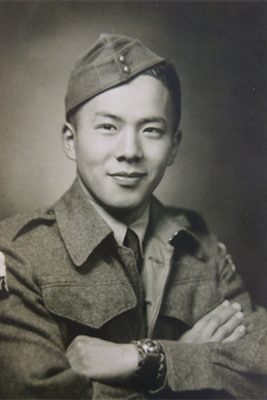
A photo of Frank taken a few days after he volunteered when the ban against Japanese Canadian soldiers enlisting was lifted. Photo courtesy: Frank Moritsugu.
During a visit with friends in Toronto, Dr. Irene Uchida—a geneticist, educator, and former fellow writer at The New Canadian—encouraged him to meet with B.K. Sandwell, editor of Saturday Night magazine. Sandwell had vocally opposed the postwar campaign to repatriate Japanese Canadians to Japan. In their meeting, Sandwell asked why some Japanese Canadians remained in B.C., despite what they experienced during the war. Moritsugu shared his thoughts, and Sandwell asked him to write an article.
After filing his story, Moritsugu began working for The New Canadian again, now in Winnipeg. He received a note from Sandwell letting him know the article had been published, and he rushed out to get a copy.
“Off I went, and the current issue was there, back on p. 57 or something—it was by Frank Moritsugu. ‘Wow,’ I thought. ‘I don’t have to go into commercial art, I can actually write,’ and that was something that never happened back in B.C.,” said Moritsugu.
With advice from Sandwell, Moritsugu enrolled at the University of Toronto, where he studied political science and economics to become a journalist.
In his first year, he began writing for the university paper, The Varsity, and by his third year, he was editor-in-chief—the first non-Caucasian to hold the role. In 1951, Moritsugu won the Canadian University Press Best Editorial award. One of the judges, Maclean’s editor Ralph Allen, invited Moritsugu to work part-time as an assistant copyeditor in his final year. By the time he graduated, he was working full-time at the magazine.
It was just the beginning of an exciting and groundbreaking career. Not only was a Japanese Canadian journalist’s byline featured in mainstream publications, but Moritsugu was covering major assignments, such as the third World Judo Championships in Paris for Sports Illustrated (he also represented Judo Canada as vice-president) and pre-Olympic coverage in Tokyo ahead of the 1964 Games.

Frank receiving the Multicultural Award from the Ontario Asian Multicultural Association in May 2014. Photo credit: Matthew O’Mara.
A lasting legacy
In many ways, this article only scratches the surface of Moritsugu’s life and career. He was a founding member of Judo Canada. He received numerous awards, including the Order of the Rising Sun from the Japanese government and the Multicultural Award from the Ontario Asian Multicultural Association.
In the 1980s, Moritsugu was active in Sodan-Kai, a group that informed Toronto-area Japanese Canadians about the burgeoning redress movement. He chaired local meetings, wrote campaign newsletters, and marched in the redress rally in April 1988 at Parliament Hill. In 2001, he wrote Teaching in Canadian Exile, chronicling the experiences of Japanese Canadian educators during the internment era.

Frank Moritsugu receives the Order of the Rising Sun from Consul General of Japan in Toronto Takako Ito in January 2019. Photo credit: Kelly Fleck.
After a long journalism career, Moritsugu worked as deputy commissioner for the Ontario Pavilion at Expo ‘70 in Osaka. He later worked as communications director for various Ontario government ministries, where he met Elizabeth “Betty” Brown. The two married in 1985.
When I interviewed Moritsugu for his 100th birthday in December 2022, he shared a binder full of family photos, letters, and newspaper clippings. “I’ve been very fortunate, in many ways,” he said. Of Betty, who was always by his side, he said, “We’re very good together, and we’ve now been together for more than 40 years. We’re lucky.”
Moritsugu is survived by his loving wife, Betty Moritsugu, and his children: Louise, Kim (Ehoud), David (Monica), Kiki, and Nina (Armin); his grandchildren, Simon, Michael, Nicholas, Natalie, Quentin, Poppy, Grace, Robin, and Torsten; his honourary grandchildren, Kelley and Kate; and his step-grandchildren, Darryl and Elise; as well as his five great-grandchildren; and his three step-great-grandchildren. He also leaves his stepson, Mike Brown (Ann), and his former stepdaughter, Fiona White (Sandy). Moritsugu was predeceased by Rolande Langlais (Louise, Kim, and David’s mother, 1951-64) and Jo Hutchings (Kiki and Nina’s mother, 1969-85).
Moritsugu made an impact by sharing his experiences—something that is not always easy to do—through talks at schools, conferences, Remembrance Day ceremonies, and his regular column Frankly Speaking in Nikkei Voice. Speaking at some of his grandchildren’s schools, Moritsugu said he loved seeing his grandchildren “beaming back” at him from the audience.
At the start of each talk, he explained why he shared his story: to ensure that what happened to Japanese Canadians will never happen again.
“Young people can turn the whole world around, if necessary,” said Moritsugu.
Though the stories Moritsugu shared were from over 80 years ago, the message resonates today. Below is part of Moritsugu’s speech to high school students, which he shared in a Frankly Speaking column in December 2019.
“War is a terrible thing. And in any war, there always are many innocent victims…It’s bad enough that able-bodied men and women in their prime, serving in the military, are killed or permanently injured doing their jobs. What is worse is that many innocent children, women, and men are often also killed or injured.
In addition, war often allows other negative side effects. In the past, going to war has allowed normally decent-thinking nations, even ours—Canada—to elbow aside the democratic civil rights and freedoms that we take for granted in peacetime. So, the story I have to tell you today provides a reminder, I hope, of what should never, never happen again. Especially in our own country.”

Frank and Betty Moritsugu at a Remembrance Day ceremony at the Japanese Canadian Cultural Center in 2013. Photo credit: Matthew O’Mara.
***
Written with files from Nikkei Voice and the JCCC’s Sedai Project. Thank you to David Moritsugu and the Moritsugu family for assistance in writing this article.




1 Comment
I was fortunate to have had the chance to meet Frank Moritsugu, an extremely kind and engaging person. My father looked forward to reading every column he wrote for the Nikkei Voice. What a phenomenal person and great leader. I hope that other Japanese-Canadians can help fill the void he leaves behind. Thank you for everything Frank.