
 15 Oct 2026
 Posted by Kelly Fleck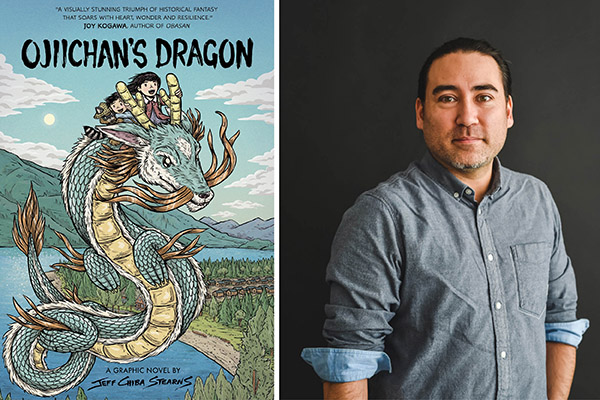

 Loading ...
Author Jeff Chiba Stearns’ launches his third graphic novel, Ojiichan’s Dragon. Left: The cover of Ojiichan’s Dragon. Right: Author, illustrator, and filmmaker Jeff Chiba Stearns.
VANCOUVER — Ojiichan’s Dragon, a new graphic novel by author, filmmaker, and animator Jeff Chiba Stearns, brings Japanese fantasy and folklore to Canadian history, exploring a dark chapter through the wonder and imagination of children.
A story about family, resilience, and how the bonds between generations can preserve culture, memory, and hope, Ojiichan’s Dragon hits bookstores across the country on Oct. 1.
Set at the New Denver internment camp between 1942 and 46, this coming-of-age story follows siblings Yuki, 10, and Takashi, 7, and their beloved Ojiichan, who introduces them to the supernatural world of yokai, mysterious spirits and creatures from Japanese folklore. The children begin to see their unfamiliar surroundings with imagination and possibility, where nature becomes a gateway to the supernatural and Japanese yokai exist in the Canadian landscape. Stearns set out to create a story that would ignite young readers’ imaginations, while also teaching them about Japanese Canadian history.
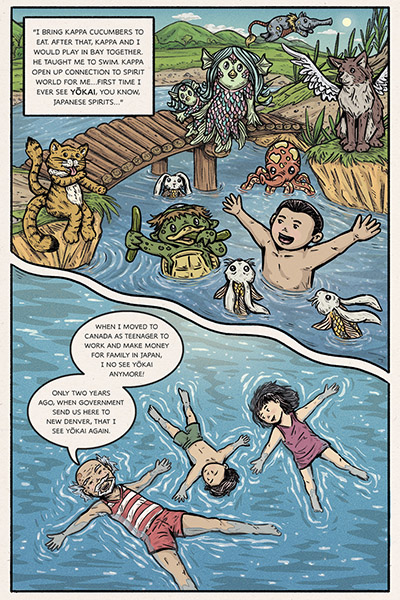
A page from Ojiichan’s Dragon by Jeff Chiba Stearns. Photo supplied by artist.
“I’m trying to make it so that kids are able to digest it and it’s something that they want to learn about,” Stearns tells Nikkei Voice in an interview. “And when they learn about it, they realize that they want to be little social justice warriors who are going to fight against injustice and know that this history can’t repeat itself.”
Ojiichan’s Dragon draws upon Stearns’ extensive research on Japanese Canadian history, identity, and heritage that is featured in many of his projects. A Yonsei originally from Kelowna, B.C., Stearns founded the Vancouver-based boutique animation studio Meditating Bunny Studios Inc. The Emmy-nominated and award-winning filmmaker’s acclaimed documentaries include One Big Hapa Family, Mixed Match, Yellow Sticky Notes, and What Are You Anyways?
Ojiichan’s Dragon is Stearns’ third graphic novel; his previous graphic novels include On Being Yukiko, created with late Sansei artist Lillian Yano Blakey, and Tomey: The Unyielding Spirit of Tomekichi Homma, about the Canadian civil rights leader. Both novels explore Japanese Canadian history through biographical stories. For this new novel, Stearns explores a fictional story, combining his historical knowledge with mythology and Japanese folklore to create a cinematic journey on the page.
“As someone who has been telling stories for 25 years, this is the one that I just always had on the back burner, that I knew had to be the right time. And I’m happy that I got to do Tomey and On Being Yukiko prior to this because it really taught me a lot,” says Stearns.
Stearns pre-launched Ojiichan’s Dragon at the 50th Powell Street Festival this summer, bringing 100 early limited-edition copies, which quickly sold out. Frequent festival-goers are likely familiar with Stearns’ artist booth each year. The festival has always been a way to connect and engage with the community, and it was meaningful to get early feedback from readers, particularly community elders, says Stearns.
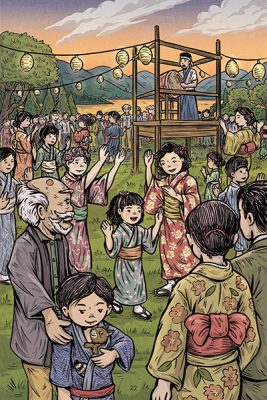
A page from Ojiichan’s Dragon by Jeff Chiba Stearns. Photo supplied by artist.
Now, learning about Japanese Canadian history is a mandatory component of grade 5 and 10 curricula in B.C. schools. Stearns wanted to create a book children would want to pick up but could still teach them about history. At the same time, Stearns wanted to create a novel adults would enjoy reading to children, hoping the novel could be a springboard for intergenerational sharing.
As the author of many children’s and teens’ books, Stearns is quite familiar with stories that interest young readers. He has also been speaking to students at schools about his novels for several years. With his books as tools, he talks about Japanese Canadian history, social justice and equality, and mixed identity. Just last year, Stearns estimates he spoke at over 40 schools, and 80 the year before. He looks forward to using Ojiichan’s Dragon as an opportunity to talk to kids about Japanese Canadian internment history. But also using the book to talk about creativity, art, and imagination.
“This is just a nice way to be able to introduce fun elements like yokai and Japanese folklore but still talk about the severity and the seriousness of the internment,” says Stearns.
While Ojiichan’s Dragon took two years to create, it was a story Stearns had been thinking about since high school. Initially, the story did not have Japanese elements, but as he learned more about Japanese Canadian identity and history throughout his career, the story began to finally take shape.
Stearns has long been fascinated by Japanese folklore and yokai, from collecting tanuki figurines and vintage Japanese pottery during trips to Japan. Growing up near Okanagan Lake in Kelowna, he would hear tales about the local lake monster, the ‘Ogopogo.’ He began to think about yokai in B.C., as if having a concentrated population of Japanese Canadians would create a connection or portal between B.C. and Japan. Unlike some Japanese folklore, the yokai in Stearns’ novel are more like gentle protectors and spiritual guides. In a way, the yokai become a metaphor for how our ancestors and their spirits connect us to the past and to our Japanese heritage.
In the novel, Yuki and Takashi listen to folktales from Ojiichan and his childhood memories of Japan, becoming the siblings’ connection to their Japanese heritage. But Ojiichan also tells the children these stories to protect them from the harsh reality of their lives in New Denver internment camp. His character honours the Issei and Nisei generations that protected their children during the forced uprooting and incarceration, so they could look at their new surroundings with curiosity and wonder.
“I don’t want to negate the fact that this was a terrible thing,” says Stearns. “It was a very terrible, hard thing for Japanese Canadians to have to experience, but understanding too that through that hardship we can find moments of love and peace and magic and spirits.”
He thought of stories like environmentalist David Suzuki, whose appreciation for nature was shaped by his childhood in a Slocan internment camp. Similarly, architect Raymond Moriyama built his first structure, a treehouse, in Bay Farm internment camp, and many of his architectural designs were inspired by the environment around them.
As the children begin to understand the reality of their circumstances, young readers learn about Japanese Canadians’ lives before the war, how families were separated, businesses and livelihoods taken, and the hardships of the time. Ojiichan was a fisherman before the war, but now his boat has been confiscated, and he is not allowed to fish in the lake in New Denver.
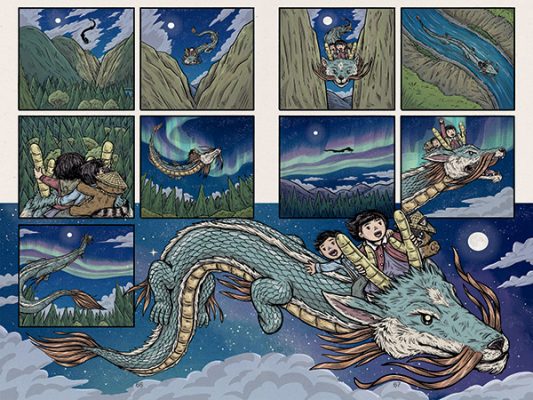
Photo supplied by artist.
Stearns brings Ojiichan’s Dragon to life with lush, dreamy illustrations, creating over 500 individual artworks for the 116-page graphic novel. Canadian landscapes are illustrated with the colours, gradations, and textures inspired by Japanese woodblock prints. Inspiration from the Studio Ghibli stories Stearns loved can be seen in the mystical characters but also in the bonds between the siblings.
Stearns knew he wanted the story to take place in New Denver because of the lake, which is central to the story. Stearns had previously visited New Denver for his documentary, One Big Hapa Family. He took two more trips to New Denver and took thousands of photographs of the landscape and the Nikkei Internment Memorial Centre, which includes wartime buildings used to house Japanese Canadians during the war.
“New Denver itself is a beautiful place, its beautiful lakes, beautiful mountains; it’s one of those places I think has magic,” says Stearns. “I wanted to make sure that that magic existed in this world that I was creating for Ojiichan’s Dragon.”
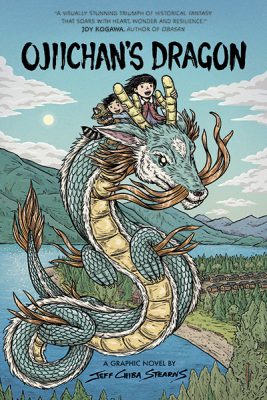
The cover of Ojiichan’s Dragon. Photo courtesy: Jeff Chiba Stearns.
Ojiichan’s Dragon is also a deeply personal project for Stearns. The children are inspired by and named after his own children. Similarly, Ojiichan is inspired by Stearns’ own grandfather. A Nisei, his grandfather was born in Canada but sent to Japan on his own as a young boy. He returned to Canada at 11 to help his family work in the farm fields and faced discrimination and limited opportunities because of his heritage and because he spoke in broken English.
“Even though he was Nisei, he always felt like he was Issei,” says Stearns. “I wanted to encapsulate that story as well, really the sacrifice they made to come here and start a new life.”
For Stearns, this feels like a story 25 years in the making, a culmination of the work, research, and projects he’s created over his career, deepened by his understanding of his history and identity, and enriched by his family and the people he has met along the way.
“Making animated films, moving into documentary, moving into kids’ books, and then getting into graphic novels, I feel like this is the one project that I’ve really just spent my whole life thinking about,” says Stearns. “All the storytelling based on identity, Japanese Canadian history, family, belonging, all led up to this moment.”
***
Ojiichan’s Dragon is now available at books stores across Canada. Learn more here.
Join Jeff Chiba Stearns for the book launch of Ojiichan’s Dragon at the Nikkei National Museum & Cultural Centre in Burnaby on Friday, Oct. 16 at 6:30 p.m. To register and for more information, click here.
Learn more about Jeff at www.meditatingbunny.com.