
 16 Oct 2026
 Posted by Kelly Fleck

 Loading ...
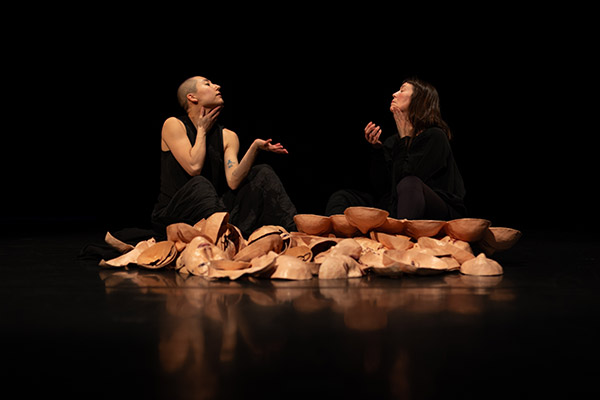
Artists Miya Turnbull and Shion Skye Carter bring performance Omote (面) to Alberta. Photo credit: Luciana D’Anunciação.
ALBERTA — In the performance Omote (面), artists Miya Kimiye Turnbull and Shion Skye Carter perform with over 100 handmade photo masks of their faces in myriad shapes and expressions. Exploring identity and expression, the artists ask: What masks do we wear every day and why?
Omote (面) makes its Alberta debut this October, where co-creators Turnbull and Carter will perform Omote (面) and host Origami + Movement workshops in Calgary, Lethbridge, and Edmonton.
Turnbull is a Halifax-based multidisciplinary visual artist. Primarily a mask-maker, her masks are self-portraits, using a photo-mask technique to make life-like representations of her face, often then playing with, distorting, and manipulating her own image. This will be a homecoming for Turnbull, who was born and raised in Onoway, Alta., and began mask-making during her BFA at the University of Lethbridge.
Carter is a Vancouver-based dance artist and choreographer, originally from Tajimi, Japan. Her choreography explores intersectional identity and heritage art forms, like calligraphy, through movement. An Iris Garland Emerging Choreographer Award winner, Carter has performed across the country, and her dance films have been screened at festivals and exhibitions globally.
The kanji 面 can be translated as omote, meaning ‘face’ or ‘surface,’ but also as men, meaning ‘mask.’ Exploring the Japanese concepts of honne (a person’s true feelings) and tatemae (their public face), the artists question how cultural expectations and ancestral history influence the parts of themselves that they want to show the world and the parts kept hidden. Omote (面) explores the masks we wear with our friends, families, at work, with strangers, and even with ourselves.
Nikkei Voice caught up with the artists to discuss Omote (面) ahead of their Alberta tour.
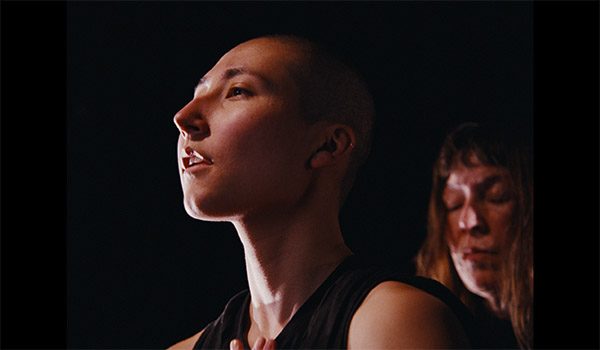
Shot from performance of Omote (面) by Skye Carter (left) and Miya Kimiye Turnbull (right). Photo credit: Dario Lozano-Thornton.
Nikkei Voice: You have now performed Omote (面) in Montreal, Toronto, Halifax, and Vancouver. How has Omote (面) continued to develop? Has presenting Omote (面) to audiences across the country further shaped the performance?
Shion Skye Carter: What I love about revisiting a project across multiple years is how we as performers can approach the choreography with a different presence or intention depending on what’s at the forefront of our minds, or what our creative interests are at that point in time. Recently, I’ve been thinking deeply about how dance is the ultimate form of respite for me, as well as the idea of art as heirlooms or traces of ourselves that we leave behind after we’re gone. Omote (面) is a work that I’m really proud of, and I hope that the residuals of what Miya and I have created (whether it’s images from our work, the masks themselves, or memories of the performance that audiences carry with them after seeing it) can remain in some way for years to come: relics of who we are as artists and human beings. I’ll be approaching the performances on this tour with these thoughts in mind and am curious about how the choreography and interacting with the masks will feel different in my body compared to past shows.
Miya Kimiye Turnbull: The biggest development for Omote (面) came between late 2024 and early 2025, when we expanded it from the original 20-minute version created through the CanAsian KickStart program and presented in Montreal and Toronto in 2023. The performances in Halifax and Vancouver were the new full-length, 50-minute version, where we kept our favourite parts and dug deeper into the creation to expand and flesh out the whole piece. This is the version we will be touring in Alberta this fall, and I am so happy to share it with the public, especially the Japanese Canadian communities in Calgary, Lethbridge and Edmonton. Even in its full-length form, Omote (面) is still living and shifting. The choreography may stay the same, but something shifts inside me each time we perform it, and I know that will bring something new into the Alberta performances especially since these places from my formative years, are so important to me.
NV: Since you first collaborated in 2022, you have continued to work together. How have you seen each other grow as artists?
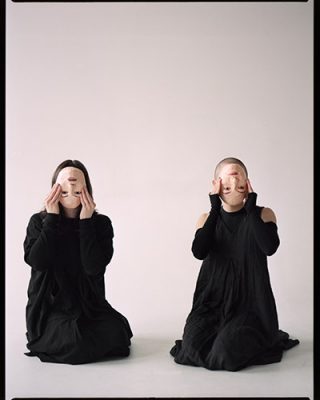
Miya Kimiye Turnbull (left) and Shion Skye Carter (right) in Omote (面), which tours Alberta this October. Photo credit: Nanne Springer.
MKT: Since our first collaboration, I have been continually inspired by Shion, and it has been an honour to keep working on and touring this project and our relationship. I see Shion’s dedication to her practice and craft, and how she is always pushing herself further, taking risks and putting herself out there. Together, we have grown from a 20-minute piece into a full-length work, a tour, and an Origami and Movement workshop we teach alongside the performances. Each step has asked more of us, and we have learned to trust each other more deeply. We are already imagining what comes next.
SSC: I think we’ve both grown and learned a lot from working together over the past four years. It’s been incredible getting to see Miya become increasingly more confident performing live, trusting her own choreographic instincts and establishing a strong stage presence. I’ve learned a lot too about what deep collaboration means and can look like, as well as how to perform with masks that often obscure or block your vision; I’ve learned how to heighten my other senses, challenging me in new ways as a dancer. Miya is incredible and I feel so lucky to work with her!
NV: You both stepped into each other’s artistic worlds to create Omote (面). What were some of the joys and challenges of exploring each other’s mediums? How has this partnership shaped you as artists you are today?
SSK: The skill-exchange aspect of our collaborative relationship has been so special. While I’ve shared my movement practice with Miya, she’s given me insight into her fascinating mask-making process too, guiding me step-by-step to make one of my own masks: one with distorted and wonky facial features, which we use in our performance. This mutual inspiration and support we continue to share with each other is something I’m so thankful for and is a key reason why Omote (面) continues to evolve as an intermingling of visual art and dance. The beauty of skill-exchange, like our project, has also greatly shaped how I approach creation across all of my projects.
MKT: I still find it extremely challenging to go on stage and use my body and choreography as part of the storytelling, but the reward of sharing the masks in real time, in a shared space with an audience, outweighs all those anxieties. I’m so grateful to Shion for opening this world up to me. It’s so powerful to show people the masks this way, and it has opened up my practice in so many ways. Shion has inspired me within my own work, especially my video performances, where I wear and perform with the masks myself. Her guidance has given me the confidence to put myself out there in a way I couldn’t before.
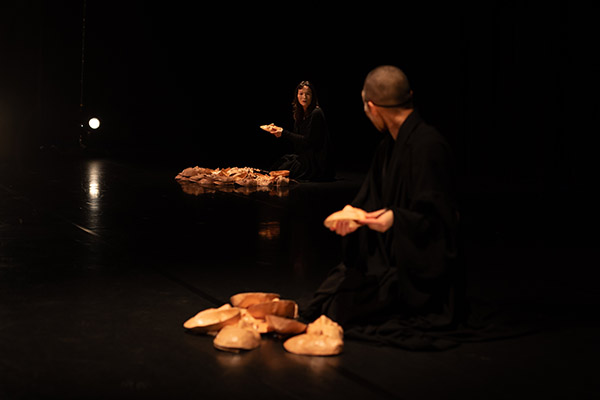
Shot from performance of Omote (面) by Miya Kimiye Turnbull and Shion Skye Carter. Photo credit: Luciana D’Anunciação.
NV: Miya, you’re based in Halifax, and Shion in Vancouver, basically on opposite ends of the country. What are the challenges of collaborating from opposite ends of the country, and how do you make it work?
MKT + SSC: We’ve been so fortunate to receive funding from the Canada Council for the Arts, which has helped cover the travel costs of working together in person to develop the choreography together. Working together in the same room has been crucial for creating our performances; everything else we do through video calls, which has opened up more possibilities for working from far away. We’re both eager to travel to work together, such as Shion traveling to Halifax so Miya can stay close to her family during creation rehearsals, and Miya traveling to the West Coast to teach our Origami + Movement Workshop at Powell Street Festival this August. Without the support from organizations and presenters to bring us together to create or perform, it would have been very challenging. We are both driven and determined to create more opportunities for ourselves, and being a team in this way makes us stronger. In a way, the distance has made our time together feel more precious, and more focused.
NV: Miya, you were born and raised in Alberta and started making masks at the University of Lethbridge 30 years ago. What does it mean to you to return with Omote (面)?
MKT: Yes, this tour to Alberta is especially exciting for me, bringing my work back “home”! I am thrilled to show friends, family and audiences what I’ve been able to do with the masks since university. It hasn’t been easy to keep up a practice. It has certainly had its ebbs and flows, and it has taken so much work, and I am proud of that. While we have presenters bringing us to Calgary and Edmonton, it was also so important for us to perform Omote (面) in Lethbridge, where I first started making masks, that we decided to present it ourselves. We’re renting a space and making it happen, because this full-circle moment matters too much to miss. I am really honoured that the University of Lethbridge has invited us to give an artist talk in their Art NOW series, and so excited to show students where it all began for me and where I’ve been able to take it. The performances in Edmonton also mean a lot to me too, since all my family is in that area, and I can finally show them this performance in person. After all these years of living so far away from them, that means everything.
NV: I’m curious if performing with masks and exploring how we present on the surface versus how we feel on the inside reflects the experiences of mixed-race Nikkei identity?
MKT + SSC: Yes, this performance in particular digs deep into both our experiences as mixed-race Nikkei. Even the title speaks to this: the kanji for Omote (面) means face, mask and surface, in contrast to what lies beneath. That tension between what people see and what we carry inside is at the heart of the piece. During our creation process, we spoke a lot about being half-Japanese, and connected over how similar our experiences were. There are moments in our choreography where we hold half masks to our faces and slide them up and down, literally in and out of alignment. For us, those moments capture what it can feel like to be mixed race: never quite lining up with how others see you, and feeling half one thing and half another, sometimes fitting together and sometimes not, always shifting depending on where you are and who’s looking.
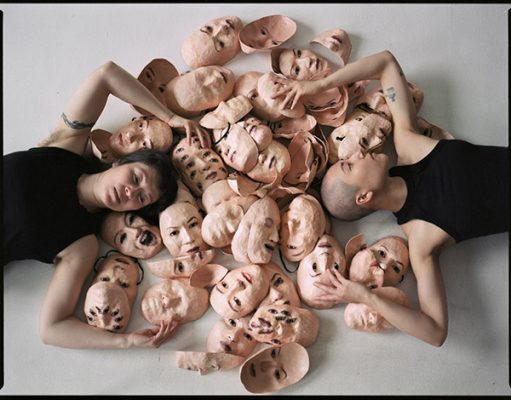
Photo credit: Nanne Springer.
NV: In the performance, you interact with over 100 handmade masks in myriad shapes, designs, and expressions. How do you hope the performance will encourage viewers to reflect on the masks they wear in everyday life?
SSC: It’s been amazing to hear different interpretations of Omote (面), and what the masks mean or represent, when chatting to audience members over the last couple of years. Something I hope resonates with those who see our work is the contrast between our inner/private and outer/public selves, and the facades we sometimes build for protection. Our performance trajectory culminates in transformation and self-actualization, and how shedding some of these protective layers to show our vulnerable insides is a form of strength, rather than a weakness. I hope audiences consider their own walls they may have built up, and how they might be able to carefully peel them apart to discover elements of their being, whether it be identity, vulnerability, or self-assuredness.
MKT: We all wear masks, not only literal ones, but the ones we put on in daily interactions and relationships. There’s the face we wear at work, with family, with strangers, and the one we keep for ourselves. The masks in Omote (面) and in my self-portrait practice come in so many variations because we hold so many versions of ourselves at once, and we are constantly changing. Near the end of the performance, Shion and I respond to the masks in opposite ways. I move toward letting them go, while Shion takes on more and more of them until she’s covered. I think both are true to everyday life. Some days we can set our masks down, and other days we need every one of them just to get through. We build these faces up over time, to protect ourselves and to fit in, and they do help us. But at some point, they can keep us from being seen and known, even by ourselves. I hope audiences reflect on the masks they wear, why they put them on, and what it might feel like to set them down. Honestly, after 30 years of making masks, I’m still learning to take them off.
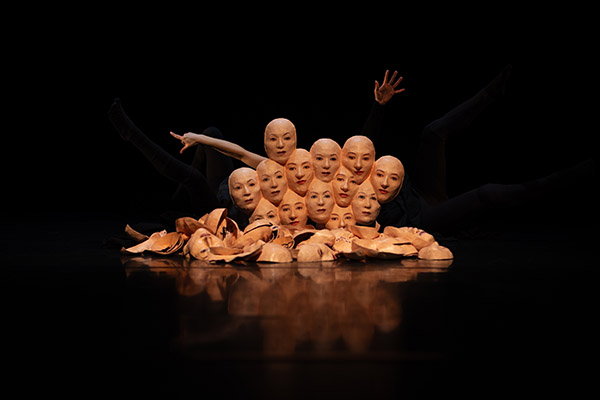
Photo credit: Luciana D’Anunciação.
Omote (面) ALBERTA TOUR
All tickets + info: https://linktr.ee/shionskye
CALGARY
Performances: Oct 24 + 25 @ 1 p.m. and 3:30 p.m., at Esker Foundation/Fluid Fest
Origami + Movement Workshop: Oct 18 @ 11 a.m., at Esker Foundation
*Note: Tickets are sold out, please contact Miya (miyamask@gmail.com) directly if interested in attending.
LETHBRIDGE
Performances: Oct 29 + 30 @ 7 p.m., at Casa Arts Centre
Origami + Movement Workshop: Oct 28 @ 6 p.m., at Bunka Centre (Nikka Yuko Japanese Gardens). Workshop registration here
Art NOW artist talk: Oct 28 @ 12 p.m., at University of Lethbridge (University Recital Hall)
Free + open to the public
EDMONTON
Performances: Nov 6 + 7 @ 7:30 p.m., at Mile Zero Dance
Origami + Movement Workshop: Nov 3 @ 5 p.m. (EJCA members) + 7 p.m. (public), at EJCA
***