
 06 Nov 2026
 Posted by nikkeivoice

 Loading ...
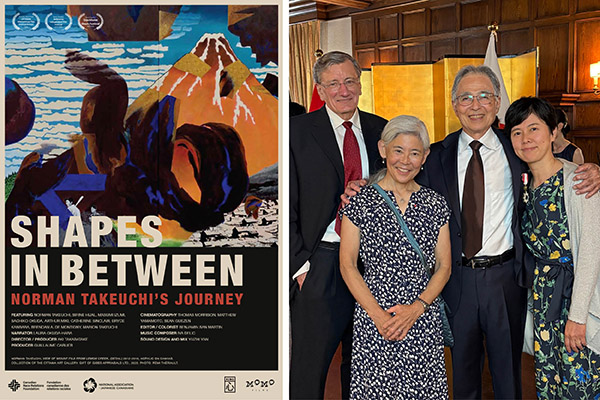
The poster for “Shapes in Between: Norman Takeuchi’s Journey.” Photo courtesy: Momo Films. Bruce, Sachiko, Norman, and Aki during the conferment ceremony, where Norman received the Order of the Rising Sun, Gold and Silver Rays at the Ambassador’s residence on July 3. Photo supplied.
TORONTO — Aki Takabatake is a Toronto-based producer, distributor, festival coordinator, and founder of Momo Films Inc., with extensive experience in Canada and Japan’s film and television industries. Her credits include Pachinko, Age of Samurai: Battle for Japan, and Mayday: Air Crash Investigation.
In 2026, Aki made her directorial debut with Shapes in Between: Norman Takeuchi’s Journey, a sensitively drawn and beautifully photographed documentary exploring the celebrated Japanese Canadian artist’s relationship with his cultural identity, family history, and wartime displacement. The film marks an exciting new chapter in her career, establishing her as a director with a distinctive interest in Japanese Canadian stories and cultural heritage.
The film has screened in festivals throughout Europe and North America and recently won the Best Documentary Award at the Japan Film Festival Los Angeles.
Nikkei Voice asked Aki about how her exciting new project came into being.
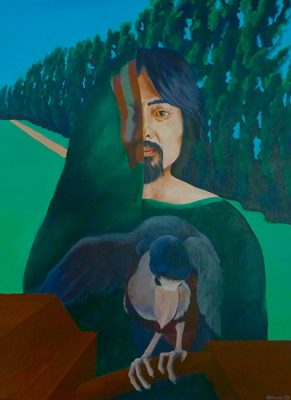
SELF PORTRAIT – MEMORIES, April 1979, Acrylic on canvas, 101.8 x 76.3 cm (40 1/8 x 30 1/16 in.) Photo courtesy of the artist.
Nikkei Voice: What inspired you to make this film?
Aki Takabatake: I first met Norman Takeuchi and his wife, Marion, by chance at the Ottawa Art Gallery (OAG), where Norman was having a retrospective exhibition. Ironically, the gallery was closed that day, so I couldn’t see the exhibition, but I happened to meet Norman and Marion as they were leaving a meeting at the gallery. We had a brief conversation and exchanged contact information.
After meeting him, I became curious about his life and artwork and started researching his background. I learned that Norman and his family had experienced the forced displacement and dispossession of Japanese Canadians during World War II. Like many Japanese Canadians of his generation, he struggled with his Japanese identity for decades.
What fascinated me most was how his encounter with an exhibition of Japanese textile artist Itchiku Kubota‘s kimono became a turning point in his life. After spending much of his life distancing himself from his Japanese heritage, Norman gradually began to embrace his roots and express his experiences and Japanese Canadian history through his art.
I found his journey incredibly moving. The idea that art could help someone confront past trauma and eventually find pride in their identity felt like a universal story worth telling.
I also realized that the history of Japanese Canadians is still largely unknown in Japan. As someone who has lived and worked in both Japan and Canada, I wanted to share this history with a wider audience through Norman’s personal journey.
NV: What new facts did you learn about Norman and the Nikkei experience through making it?
AT: One of the most striking things I learned was how deeply the wartime experience affected Norman’s sense of identity, even decades after the war.
Norman was born in Vancouver in 1937, and his family was among the Japanese Canadians who were uprooted from their homes during World War II. What particularly surprised me was that he continued to reject his Japanese heritage until he was nearly 60 years old.
As someone originally from Japan who has lived in Canada for many years, I found that very moving. Today, when I tell Canadians that I’m Japanese, the reaction is almost always positive. People often tell me how much they love Japan. It made me reflect on how different things were for Norman’s generation, when being Japanese could be a source of discrimination, shame, and exclusion.
Through making this film, I gained a deeper appreciation of how historical injustice can affect not only people’s lives but also their sense of identity for generations.
One of the most memorable things Norman told me was that, after everything he had been through, he had finally reached a point where he could proudly say that he was Japanese Canadian.
I think his story is particularly relevant today, when we continue to see discrimination against immigrants, refugees, and people from different cultural backgrounds around the world. I hope the film encourages audiences to reflect on history and the importance of understanding other people’s experiences.
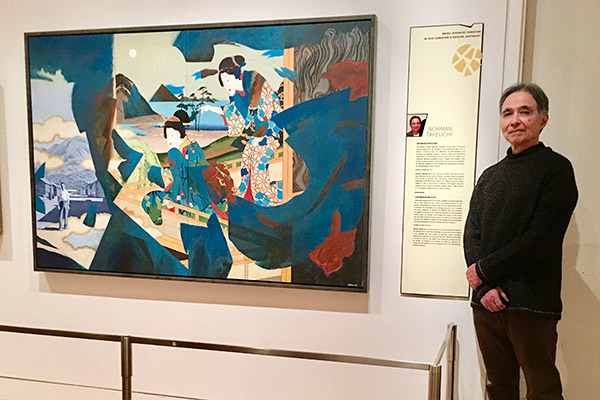
Norman Takeuchi with his piece, Interior Revisited, during the Being Japanese Canadian group exhibition at the Royal Ontario Museum in 2019. Photo supplied.
NV: What do you think makes Norman’s art so compelling to both Canadian and Japanese audiences?
AT: I think what makes Norman’s art so powerful is that it is deeply personal, yet its themes are universal.
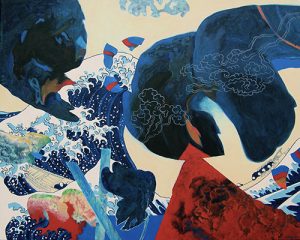
THE GREAT WAVE, 2008, Acrylic on canvas, 81.2 x 101.5 cm (32 x 40 in.) “Water” exhibition, Cube Gallery, April 8 – May 17, 2009
Bought by Sharon Khan through Cube Gallery
His work reflects his own experiences as a Japanese Canadian, including displacement, discrimination, cultural identity, and the process of coming to terms with his heritage. But these are also themes that people from many different backgrounds can relate to.
For Canadian audiences, his artwork provides an important perspective on a painful chapter of Canadian history. It reminds us of the injustices Japanese Canadians experienced during World War II and how those experiences continued to shape their lives long afterward.
For Japanese audiences, I think his work offers an opportunity to discover a part of Japanese diaspora history that is not widely known in Japan. It also raises interesting questions about what it means to be Japanese when you are born and raised outside Japan.
What I also love about Norman is that his artistic style has continued to evolve throughout his career. His work is not limited to one particular style or subject, and I find that creativity and willingness to explore different forms of expression very inspiring.
Ultimately, I think his art resonates because it is not simply about the past. It is about finding your identity, accepting who you are, and transforming difficult experiences into something meaningful.
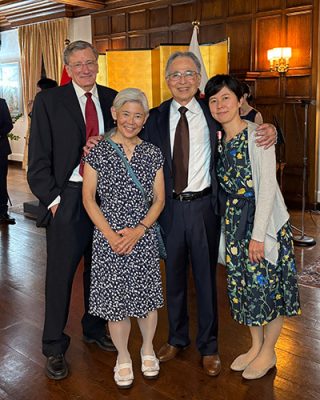
Bruce, Sachiko, Norman, and Aki during the conferment ceremony, where Norman received the Order of the Rising Sun, Gold and Silver Rays at the Ambassador’s residence on July 3. Photo supplied.
NV: This is your first film, and you have already won an award! What is next? A narrative film? A feature?
AT: Thank you! Winning the Best Documentary Award at the Japan Film Festival Los Angeles was a wonderful surprise.
I studied Film Studies at the University of British Columbia, but my background was more academic, focusing on film history and theory rather than filmmaking. I spent many years working in film acquisition, distribution, and programming, and later became involved in production through research, interpretation, and coordination. I never really imagined myself becoming a director.
When I first started developing this documentary, I actually intended to be the producer and hoped to find a Japanese Canadian director. However, the directors I approached were all busy with their own projects, and time was running out before Norman’s exhibition at OAG ended. So, I decided to organize the shoot myself, and that’s how I unexpectedly became the director.
Making this 15-minute documentary took nearly three years, and I learned an enormous amount about filmmaking, fundraising, and the challenges of independent production. We received generous support from the National Association of Japanese Canadians (NAJC) and the Canadian Race Relations Foundation (CRRF), but I also had to contribute my own money to complete the film. I jokingly told myself that it was my film school tuition!
I originally hoped to make a feature-length documentary about Norman, but budget limitations meant that we had to tell the story in a shorter format.
As for what’s next, I would love to direct another documentary about Japanese Canadian history or experiences if the right opportunity comes along.
At the same time, I’m increasingly involved in producing and developing projects with other filmmakers through my company, Momo Films. I enjoy being able to work on different stories and genres, including narrative films. I’m not sure when I’ll have the opportunity to direct again, but this experience has definitely given me the confidence and motivation to take on another project in the future.
***
Shapes in Between: Norman Takeuchi’s Journey will screen at the Vancouver Asian Film Festival on Nov. 7 at 2 p.m. For tickets, visit: www.goelevent.com/vaff/e/Program6-DOCUMENTARYSHORTS