

 19 Oct 2026
 Posted by Kelly Fleck

 Loading ...
Artist A.S.M. Kobayashi brings visitors along to uncover family history at the Art Gallery of Mississauga. Photo credit Toni Hafkenscheid.
MISSISSAUGA — While many families have precious heirlooms and keepsakes that connect them to their ancestors and history, it was the absence of these items that led interdisciplinary artist A.S.M. Kobayashi to uncover her family’s story.
Instead, Kobayashi has documents, transcripts, letters, and meticulous inventories of her ancestors’ home, property, and everything within that was taken, documenting their forced uprooting, dispossession, and incarceration by the Canadian government in 1942.
Using these documents as a guide, Kobayashi invites viewers to join her as she pieces together her family’s story through a truly unique and moving exhibition. Kobayashi’s Electric Neon Clock, a hybrid immersive art installation of sculpture, documentary, and performance, is at the Art Gallery of Mississauga until Oct. 25.
The exhibition is a homecoming for Kobayashi, who was born and raised in Mississauga and is now based between Toronto and New York City. The award-winning artist has exhibited work at museums and film festivals nationally and internationally.
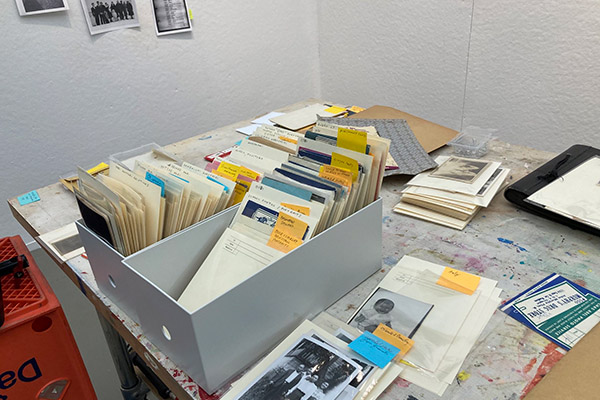
A behind the scenes look at A.S.M. Kobayashi’s research process. Photo courtesy of the artist.
Kobayashi’s work often revolves around finding a lost or forgotten object and carefully unravelling its story, transforming it into a performance or film project. Her critically acclaimed project, Say Something Bunny! (2017-2020), began with an audio recording of an unidentified family at a gathering, which she methodically studied, tracing it to a Jewish family in New York City in the 1950s.
“My work for the last 20 years has been about finding an object…that’s often discarded, lost, or thrown away, and then trying to uncover what can be understood about the person who owned it,” Kobayashi tells Nikkei Voice in an interview. “This is so connected in this subconscious way to my family’s dispossession…to look at these objects and ask, ‘Why is this significant to a person? Why does this have meaning?’”
For Electric Neon Clock, Kobayashi turned her focus to her own family’s story. The project began with an email from her father and a link to a 119-page file about her great-grandfather, Kamekichi Kobayashi. Found in the Landscapes of Injustice archives from the University of Victoria, the file documents Kamekichi’s history during the Second World War through the perspective of government officials.
Kobayashi injects life into these documents once meant to dehumanize her family, reducing her great-grandfather, his life and livelihood, to a case file number. Through videos, photos, archival documents, and a live auction, she invites audiences to uncover the stories behind her family’s case file and, in doing so, humanize its contents.
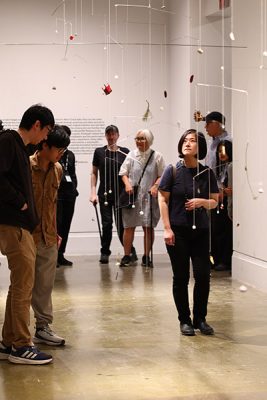
Visitors view Small Forest during the Electric Neon Clock opening at the Art Gallery of Mississauga. Photo credit Toni Hafkenscheid.
Electric Neon Clock offers audiences a chance to explore this dark history with moments of levity and curiosity. The installation begins with a giant, delicately balanced mobile that extends an entire hallway. The mobile branches off into smaller mobiles balanced with various small objects tied with clear string. Called Small Forest, the mobile is a sculptural family tree, with each offshoot representing a branch of the Kobayashi family.
“Kobayashi means ‘small forest,’” says Kobayashi. “It’s a constellation of these little trees that build into this small family tree forest.”
Each family member is represented by dollhouse pieces, sugar cubes, and tiny natural objects, like leaves, sticks, and rocks. The objects were collected by Kobayashi’s two-year-old daughter and other young children in the Kobayashi family, honouring her father’s generation, who were young children during the internment and postwar years.
The mobile leads visitors down a hallway, which AGM Senior Curator Shannon Anderson relates to a train bringing the family across the country. Visitors can watch the short film, File No. 2304, where Kobayashi shows how she used the case files to understand her family’s history, before leading visitors into the main gallery.
In 1942, Kamekichi, his wife, five of their six adult children, and their children were forced to leave their property in Steveston. The family was sent to Morris, Manitoba, to work on sugar beet farms. Before the war, Kamekichi built a successful life, with three fishing boats and a farm, raising chickens and selling strawberries and loganberries.
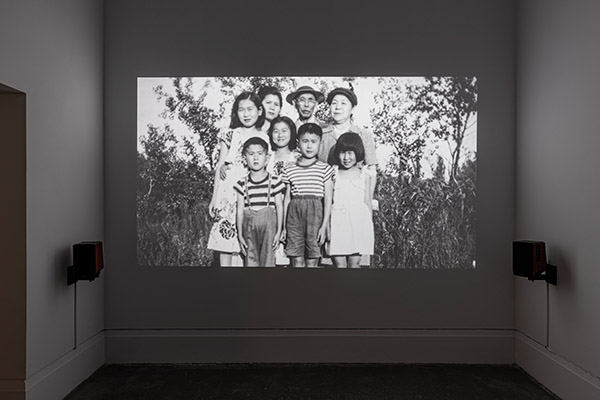
The short film File No. 2304 screens at the gallery. Photo credit Toni Hafkenscheid.
After the war, the family was scattered across the country. The history was not often talked about, and the silence became a protection; the family wanted to move on with their lives. As time went on, family members got used to not asking questions as much as not answering them.
“It almost was like they were protected from knowing all the details. But it was also a combination of no one was asking, no one was telling the history,” says Kobayashi.
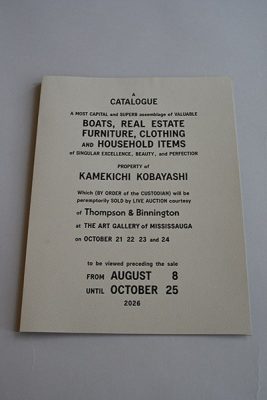
The auction catalogue/artist book. Photo courtesy of the artist.
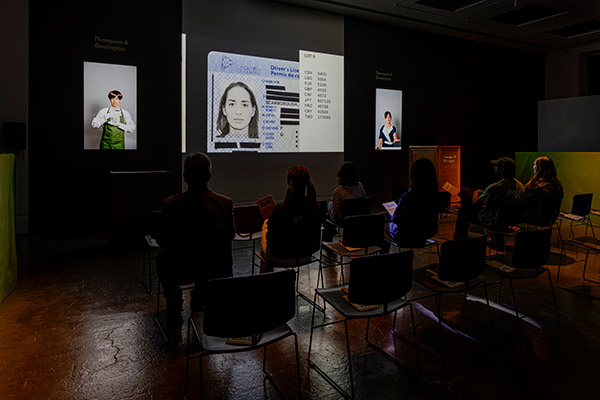
Electric Neon Clock transforms the main gallery into an auction house. Visitors are greeted by signage for Thompson & Binnington, a real-life auction house that participated in the dispossession of Japanese Canadians.
Beside the sign is a portrait of the Kobayashi family in Manitoba around 1943. Found in the Library and Archives Canada collection, the photo was part of a postwar publicity campaign showing Japanese Canadians resettling across the country. Like the case files, it was another piece of Kobayashi’s family that quietly existed in government archives for decades.
Visitors can take a seat in the dark gallery where an auction catalogue and paddle wait for them. The catalogue documents the Kobayashi family collection up for auction, which includes all the family’s possessions listed in Kamekichi’s case file.
The auction is split into nine lots, each representing a different way the Kobayashi family was dispossessed. The first lot is the family’s fishing boats, then their furniture and household items, then their home, land, crops, and chicken coops, then their clothing and personal items, down to even food and trash.
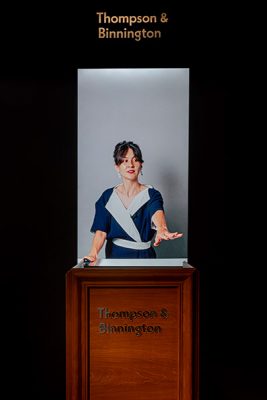
A.S.M. Kobayashi as the auctioneer. Photo credit Toni Hafkenscheid.
An auction plays out in front of the audience in the gallery. An item is projected on the screen with its assigned value. Two additional screens awaken on either side of the main screen, one of an auctioneer who begins the bidding and the other of a handler with the item (both performed by Kobayashi).
As bidding begins, different seats are illuminated by a spotlight, as if the person in that seat has made a bid. The spotlight jumps from seat to seat as the auctioneer calls the bids, until the gavel bangs; the lot has been sold to the highest bidder.
Between each lot’s auction, the video switches to a more documentary style, explaining details of Kamekichi’s file and Kobayashi’s research. Letters and court transcripts are read by members of the Kobayashi family, and a story begins to take shape.
Audiences will likely notice something strange about this auction. Each lot is represented by an object that does not match what is being auctioned. The real items belonging to the Kobayashi family are now long gone, sold during the war, destroyed, disposed of, or lost to time.
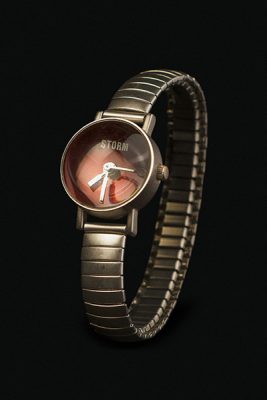
Louise Noguchi’s watch for auction. Photo courtesy: A.S.M. Kobayashi.
Instead, she borrowed proxy items from people in the Japanese Canadian community. Kobayashi borrowed a set of keys from architect Bruce Kuwabara to represent the family’s house and a wristwatch from teacher and fellow artist Louise Noguchi to represent the titular electric neon clock.
Thoughtful details are layered throughout the installation. The auction’s starting prices match the amount the items were hastily sold for by the government during the war (adjusted for inflation). But the final bidding price—which is significantly higher—matches the value the family assigned to their possessions. The auction house is decorated in green with a wooden auctioneer stand to resemble the parliamentary green of the House of Commons. While the numbers on the auction paddles may appear random, they represent family case file numbers for those who participated in the project.
The installation culminates with a live performance at the gallery from Oct. 21 to 24. Kobayashi will act as the auctioneer in a live performance, accompanied by musician and composer Bradley Kurushima, who created the score for Electric Neon Clock. Instead of proxy items, Kobayashi will borrow items from the audience with a promise to return them—unlike the Office of the Custodian.
For Kobayashi, creating this work also led to a deeper understanding of her Japanese Canadian identity. It’s connected her to fellow artists and to community organizations and institutions. Part of the work was created during an artist residency at the Japanese Canadian Cultural Centre.
But it also connected her to long-lost relatives living across the country. It highlighted the assimilation her family and many others experienced after the war. Many shed parts of themselves to fit in, which led to a loss of culture, language, and identity.
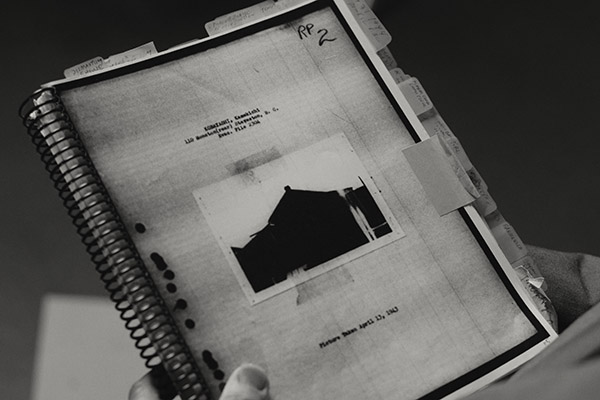
Kobayashi’s family case file. Photo courtesy of the artist.
Kobayashi wanted to create an accessible way to learn history and ask questions. The custodial case files are sterile, dense, and can be hard to read through. Creating an interactive exhibition connects the documents and history to real people—her family—and brings them to life.
“For some of us, this is what we have access to because that generation has passed away. I hope that this exhibition can be an example of a way to access that history, even though it’s through this governmental perspective, but that it can still be there or be a starting place to ask questions,” says Kobayashi.
***
Electric Neon Clock is at the Art Gallery of Mississauga until Oct. 25. Join A.S.M. Kobayashi for the live performances of Electric Neon Clock from Oct. 21 to 24, 7:30 to 9 p.m.
For tickets and more information, visit: www.artgalleryofmississauga.com/events/a-s-m-kobayashi-electric-neon-clock/